Robotic Floor Scrubbers – The Future of Autonomous Cleaning at Airports
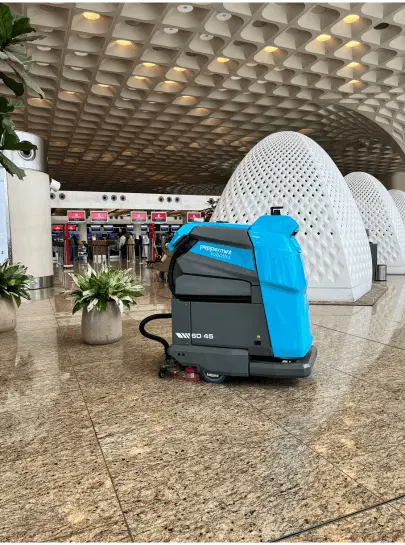
How do robotic floor scrubbers work?
Robotic floor scrubbers are autonomous machines designed to clean floors without an operator at the controls. They combine cameras and lidar to map their environment and plan a cleaning route, with infrared and ultrasonic sensors to detect obstacles and avoid collisions along the way.
The robot's onboard computer uses this map to plan a path, then drives its brushes and squeegees across the floor while suction and filtration systems lift dirt and debris as it goes. Airport floor scrubbers can be scheduled to run during low-traffic hours, cover multiple zones in sequence, and be monitored or redirected remotely, improving cleaning efficiency and consistency compared with a fully manual routine.
Why airports are automating cleaning
Airports have had to raise the bar on visible cleanliness while keeping terminals open and moving. Autonomous mobile robots (AMRs) are increasingly deployed for exactly that: keeping concourses clean without pulling staff off other work or interrupting passenger flow.
High-traffic zones (checkpoints, food courts, hold rooms, jet bridges) need constant attention, and so do lower-visibility but equally critical areas like crew rooms and back-of-house corridors. Covering all of it with manual labor alone is expensive and hard to schedule consistently, which is why more airports are turning to robotic floor scrubbers to fill the gap.
Peppermint Robotics at GMR Hyderabad
GMR Airport has deployed Peppermint Robotics' autonomous floor scrubbers to improve efficiency and consistency in its cleaning operations, citing gains in accuracy, time saved, and cost-effectiveness, while keeping terminals cleaner for passengers and reducing operating expenditure.
Peppermint's robots run a meaningful share of the floor-cleaning workload at GMR Hyderabad Airport, which has been recognized as India's fifth-cleanest airport by a Times of India report. GMR Innovex has since launched a Robotics Center of Excellence for Airports and signed an MOU with Peppermint Robotics, SINE IIT Bombay, and Flo Mobility to explore further robotics use cases across airports.
Efficiency and consistency
Robotic floor scrubbers can run continuously and on a fixed schedule, covering large areas quickly and thoroughly without the variability that comes with shift changes or staffing gaps. Because the same route and standard is programmed in, high-traffic zones that need extra attention get it every time, not just when there is capacity.
Cost and safety
Fewer cleaning staff are needed to maintain the same standard, and automation reduces exposure to repetitive-strain injuries from manual scrubbing as well as to the cleaning chemicals used in hazardous or hard-to-access areas. That combination (lower labor cost and lower injury risk) is a large part of the business case airports make internally.
It also frees staff for higher-value work, like guest-facing service, while remote monitoring lets facilities teams check on cleaning progress and adjust schedules without walking the floor themselves.
What this means for the industry
Robotic floor scrubbers can track exactly what has been cleaned and when, giving airports a verifiable record rather than a best guess, important for both passenger-facing hygiene standards and internal reporting. Because the robots do not need rest, round-the-clock cleaning becomes practical in a way that is difficult to staff manually.
This kind of automation is part of a broader shift: more airports are adopting robotic cleaning to keep pace with rising hygiene expectations while managing labor availability and cost. As the technology matures, expect the case for it to keep getting stronger.
Why choose Peppermint Robotics
We work closely with airport operations teams to understand their layout, traffic patterns, and cleaning standards, then tailor deployment around them rather than asking facilities to adapt to the robot. Our floor scrubbing robots, including the SD-45, are already running in major airports and large facilities, designed to make cleaning more productive, cost-effective, and easier to manage day to day.